Valentine’s Day Card Template
A Watercolor Wreath That Feels Handmade—Before a Single Stitch
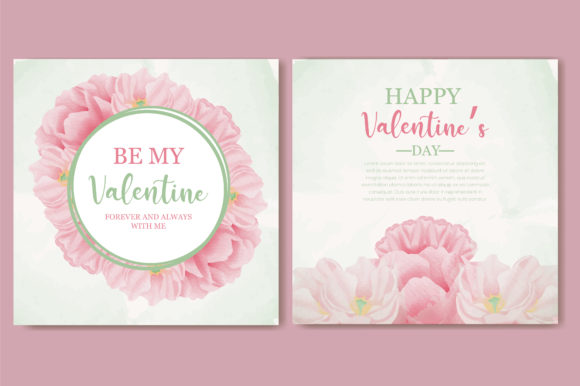
First glance at the Valentine’s Day Card Template is like opening a quiet, thoughtful note: soft-edged tulips and leaves arranged in a gentle square wreath, all rendered in delicate watercolor strokes. It doesn’t shout—it breathes. That matters. As someone who’s stitched hundreds of client projects—from boutique baby onesies to limited-run embroidered aprons—I immediately ask: *Does this translate to thread? Does it hold up when scaled, stabilized, and stitched on real fabric?* The answer isn’t yes or no—it’s *“Yes—if you treat it like the subtle, layered design it is.”*
Where This Template Naturally Lives in Real Embroidery Work
I recently tested the Valentine’s Day Card Template as a central motif for a custom embroidered linen tea towel—intended for a local gift shop’s Valentine’s pop-up. Not as a printed card, but as a stitched emblem: centered, 4.5" wide, with raw-edge linen backing and tonal pink thread. It worked beautifully—not because it’s “bold,” but because its watercolor softness translated into elegant satin and fill stitch transitions. The petals weren’t rigid outlines; they bloomed with gentle density shifts, mimicking brushstrokes in thread. That same sensibility carries into sweatshirt embroidery (on midweight French terry), pillow covers (cotton duck), and even baby bodysuits (with lightweight tear-away stabilizer). It’s a design that supports quiet luxury—not loud branding.
What Shifts When You Move From Print to Stitch
Remember: this is a Print Template, not an embroidery file. That distinction is critical. The JPG and PNG files give you layout, color intent (CMYK), and bleed area—but zero stitch data. So before embroidering, you’ll need digitizing—or a trusted digitizer. I recommend starting with the PNG version: its transparency preserves clean edges around the wreath, making vector tracing easier. The double-sided square format also means you can mirror elements for symmetrical placement on tote bags or reversible patches. But here’s what requires attention:
- Small details: Those fine watercolor veins in the tulip petals won’t survive dense fill stitch at under 3". Test them at 2.75" on scrap fabric first—some may need slight simplification for clarity.
- Curved surfaces: On caps or curved pillow corners, the square shape holds well—but avoid placing the wreath too close to seams or brims where distortion pulls petals out of alignment.
- Dark or textured fabrics: The watercolor effect relies on tonal gradation. On charcoal twill or bouclé knit, consider light-contrast thread (ivory, blush, pale sage) and add a layer of medium-cutaway stabilizer to prevent shadowing in the fill areas.
- Frequent-wash items: For kitchen towels or baby items, confirm your digitizer uses balanced stitch density—no over-stuffed centers that’ll stiffen or crack after laundering.
Why This Template Builds Trust—Not Just Decoration
Customers don’t buy “a floral wreath.” They buy *care*. The Valentine’s Day Card Template signals intentionality: hand-drawn, seasonal, tender. When stitched onto a cotton apron for a baker’s Valentine’s special order, it felt personal—not mass-produced. That perception lifts perceived value, especially for Etsy sellers and small shop owners pricing handmade products. It also reinforces brand consistency if you use it across complementary items: a matching embroidered patch + printable card bundle, or a sweatshirt + tea towel set styled with the same wreath motif. Just be sure your license permits commercial use—since this falls under Graphics, verify redistribution rights before bundling with digital embroidery files or reselling as part of a craft kit.
Practical Notes Every Embroidery Designer Should Check
- Test on scrap first—especially with stretchy knits or thin chambray. Watercolor softness can blur if stabilizer isn’t matched to fabric weight.
- Review thread color contrast in both light and dark mockups. That CMYK palette guides dye choices, but thread sheen changes perception—test matte vs. rayon on your target fabric.
- Confirm hoop size compatibility. The square layout fits standard 5x7" hoops cleanly, but if you’re scaling down for baby hats or keychains, re-evaluate petal spacing and leaf overlap.
- Inspect corners and inner curves. The wreath’s negative space between stems needs clean jump stitches—ask your digitizer to minimize trims there.
- Use black-and-white mockups to assess visual hierarchy. If the design flattens into a single gray mass, adjust stitch direction or add subtle outlining.
- Check licensing before selling finished items or digital assets. Since this is a Print Template, not a machine embroidery design, usage terms likely differ from applique design or pre-digitized files.
Final Thought: A Template With Quiet Confidence
The Valentine’s Day Card Template won’t dominate a busy market table—but it will stop someone mid-browse. Its strength lies in restraint: the kind of design that makes a customer pause, tilt their head, and say, *“That feels like it was made just for me.”* Whether you’re stitching personalized gifts, building a cohesive holiday collection, or sourcing refined design assets for your craft business, this template earns its place by supporting authenticity—not replacing it. Use it thoughtfully, digitize with respect for its watercolor soul, and let the stitching do the quiet talking.